





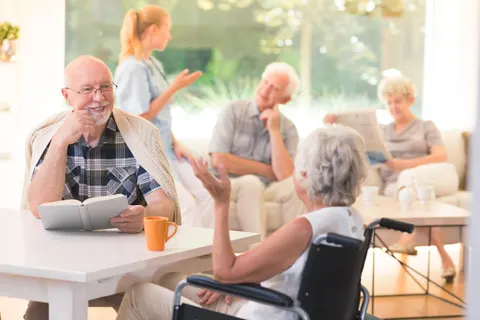
The majority of individuals view a transition to a retirement community as a last resort – a necessity when the responsibilities of homeowning become too demanding, or one’s family becomes too concerned. This perspective is mistaken. For retirees besieged by suburban solitude, communal living is more akin to a prophylactic than a treatment.
The biology behind belonging
Loneliness is not just a feeling; it’s a biological warning signal. Persistent loneliness raises cortisol levels, causes insomnia, and weakens the immune system. There are measurable effects: a 50% increase in dementia risk and a 29% increase in heart disease risk among older people who are socially isolated (National Academies of Sciences, Engineering, and Medicine).
Retirement can inadvertently isolate people. When you retire, you lose contact with an organization that once provided daily engagement. Your children and friends move or live far away from you. Your physically large suburban house can become relatively empty of human life. But this isolation is slowly induced and is hard to detect. No sirens, no obvious danger signs. Just a quiet social life that keeps shrinking.
Retirement living is a modest intervention that avoids dangerous late-life isolation.
The quiet architecture of daily connection
A lot of the talk around community is about the activities – the pottery class, the golf leagues, the organized outings. They matter, but they’re not the whole picture. The more powerful factor is what happens between the events in the activity calendar. The neighbor who waves from her balcony every morning. The familiar face in the mailroom. The person who always takes the same table at breakfast. These low-stakes encounters are the background hum of belonging, and scheduled programming can’t replicate them. Psychologists call this the propinquity effect – we form the most meaningful connections with the people we bump into often in a shared space, with no formal efforts at relationship-building.
Communal dining is a perfect example. Eating alone is one of the most invisible causes of senior loneliness. Sharing a dining room, even if you’re not having a deep conversation, is a way to reintroduce a basic social rhythm that most people don’t realize they’ve missed until they have it again.
Peer monitoring as a safety net
One aspect of retirement community life that is often overlooked is this informal peer-to-peer monitoring. When people are familiar enough with each other to recognize when something is different, problems are caught early. If a regular on the morning walk isn’t there for two days, a neighbor sees that. Such organic watchfulness has no overhead costs. It arises simply from being there and knowing each other. And it is a type of reassurance that is real for both residents and their families, in a way it cannot be for the aging in an isolated dwelling.
Freeing up time and mental energy
Owning a home adds more stress and responsibilities to your life, especially as you get older. With things like maintenance, yard work, seasonal preparations, and repairs, it’s not just physical exertion that adds up — it’s also mental stress and worrying about these tasks. Many retirees spend much of their week tending to a home, rather than enjoying their retirement.
Choosing a managed community helps eliminate these responsibilities. And it’s not just added free time you’re left with, it’s the kind of time that can be committed to social activities, exercise, and engagement with others, which research has shown is common in areas where people tend to live longer lives.
Of course, for many people, including those looking at Senior apartments Minnesota, the community’s location in relation to family is the most important consideration. The best options strike a fine balance between accessibility to family and meaningful amenities — fitness facilities, common spaces, and programming that gives residents something to return to.
Getting through the transition
The first months of life in a new place are always the toughest. Every inhabitant is a stranger, and forming relationships when you’re in your sixties or seventies doesn’t have the same association mechanisms that school or early career had.
The most useful tip is to join one interest-based group early—a book club, a gardening committee, a walking group—instead of trying to sample everything at once. An activity in common gives you a reason to encounter the same people multiple times, and that’s the precise condition of affairs necessary for connection to grow over time. Most communities have an activities director whose job it is to grease that skid for you, so the newly arrived don’t have to figure it out for themselves.
Independent living and assisted living are at different points on the care spectrum, but in both cases, the social form is built in from the start. You don’t have to figure out how to be a community. It’s there, and you can join in to whatever extent feels comfortable.
The real shift in how we think about this decision
Deciding what retirement community to move to isn’t easy. There are dozens of critical factors to consider – from location, cost and quality of medical care to the availability of social programming. With so many variables in the mix, for most people, a single factor probably breaks the tie. Maybe for you, that’s location. Maybe it’s cost. Maybe it’s something random like pool availability. But the true north that animated those variables is that you want a life that allows you to be as active as possible for as long as possible.