






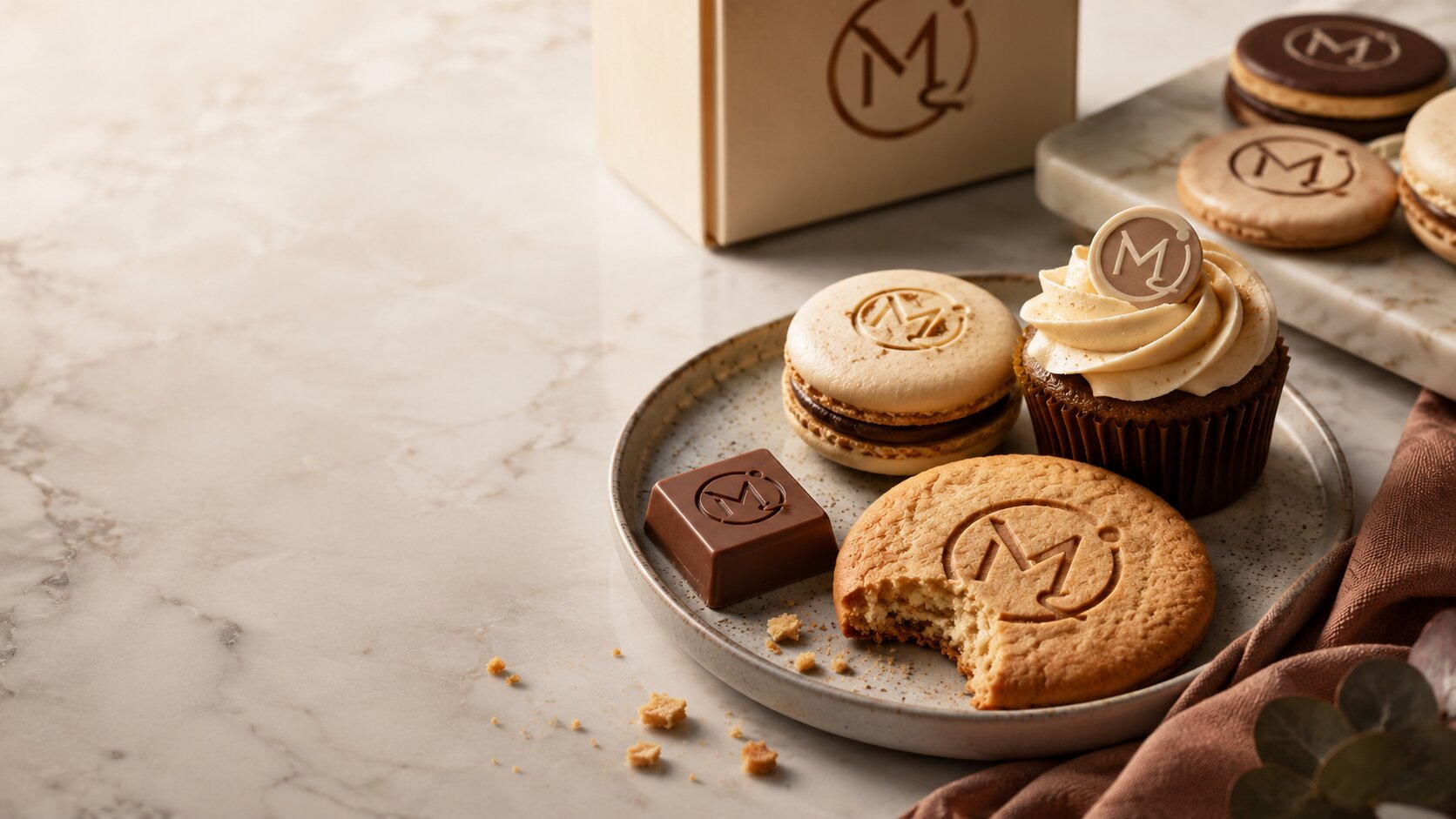
Many business presents are thrown away. A pen is likely to be lost, and a bag forgotten. However, people don’t ignore something to eat. Our sense of taste and smell is tied to the limbic system, the part of the brain responsible for memory and emotions and that’s an important connection.
Edible branding is not a gimmick. It’s an effective sensory marketing tool because it engages with people in a way that a regular ad or brochure cannot.
Why swag fatigue is real – and costly
Businesses allocate a significant amount of their budget to advertising swag each year, and unfortunately, much of it ends up in the trash. People don’t want or need another branded, subpar-quality mug. They kept one just like it, and it didn’t take long for it to end up in the break room cabinet, a bottom-shelf cupboard, or the donation bin.
Generically branded swag is meant to be kept but all too often never is. A consumable product changes that reality altogether. When a client, employee, or prospect receives a beautiful, delicious, yet subtly branded food gift, they don’t put it away and forget about it. They happily enjoy it. And when a gift is consumed, it’s not discarded – which nowadays is more important to clients and employees than it was a decade ago.
This is why edible branding should be a key weapon in your corporate gift arsenal. It’s premium, it’s perishable, and it respects the recipient’s space.
Edible gifts as trade show tools
Trade shows are noisy, busy, and cutthroat. Every booth is vying for attention from the same mass of people. Every handout gets lost in the shuffle. Every free tote bag ends up in a closet somewhere. What stops someone in their tracks is a giveaway that they can eat right then, and there’s nothing more powerful than hunger.
But beyond the simple, instinct-driven draw of food, there’s an elegance to branded treats as a trade show promotional tactic. They are, in a sense, the ultimate icebreaker. An attendee stops to grab a cookie. While they’re looking at the cookie, they’re already considering eating a bite and what it might taste like, which gives them a moment or two to glance at your booth. The elevator pitch you’ve spent years perfecting suddenly has an audience and all it took was a dessert. Custom logo cookies for events dramatically lower the barrier to engaging because there’s mutual desire for you to be there (you having more cookies). The same cannot be said for a sales rep.
The reciprocity effect in practice
A common psychological principle explains this. When someone is given something that is truly nice, naturally, they want to give something back to you, out of pure kindness. Giving a special gift shows that you recognize someone as an individual, not just a potential customer. That change in perspective leads to increased client retention.
Customers are more receptive to brands that they gain a connection with through more than just an advertisement. Branded items are a gift they can take away and remember a brand from, rather than just be an annoyance that they’re scrolling past online.
But most salespeople probably don’t need statistics to know this. They probably already understand that a physical item can achieve things that an email marketing campaign never could. It creates an experience. The flavors and smells of that experience will translate into a memory associated with your business.
Getting the execution right
This only matters if the product itself is on par with your aspirations. A cookie covered in quickly-smearing frosting isn’t saying “high-end brand,” it’s saying the opposite. And as with anything pretty, the design only gets you so far. How that design is translated to reality – more particularly to an item someone’s going to eat – is where things really matter if you’re going for more than a three-second win.
Color matching is one small part of that. Things like frosting colors that match your brand’s precise hues because your production partner takes the time to color-match them matters in making sure your visual identity is consistent. The same care you’d take in OK’ing a business card proof should be the same level of care you put into any food item that’s a stand-in for your business card.
Then a reality check. Time and mileage have to be built into how long this stuff will actually be on the shelf and how far across the country it’s coming to meet you. If your edibles arrive slightly the worse for wear, it’s not that your cookie broke that’s the problem, it’s that you’ve put something negative in your customer’s hand. This should be a given requirement for any supplier, not a special request – after all, a product that’s crumbling or past its prime is a failed product and a negative message of your brand.
The lasting impression comes from the experience
A digital ad is gone the instant you scroll by. A printed brochure is one of many in a pile. An edible branded gift is eaten, enjoyed, often shared in a social setting.
This is the real case for edible branding as a corporate gift strategy. It doesn’t demand attention – it commands it. Through a sensory experience that not even an inbox full of mundane emails can diminish. Smart brands get this. They’re not just being innovative, they’re being tactical about where the memory is actually formed.